CCNA Practice Exam: A Free Full-Length 200-301 Test With Domain-Level Feedback
Most people who fail the CCNA did not run out of knowledge. They ran out of time on questions they half-knew, or they lost points steadily across one domain they had quietly avoided for six weeks. A practice exam is only worth sitting if it exposes both of those - the timing and the shape - and then tells you which one is costing you more. That is what this one is built to do.
Sit one before you read another chapter
A complete CCNA 200-301 exam across every domain, with an explanation and an Exam Tip on every item and a personalized Exam Coach at the end. Create an account on the next screen and the code applies itself - no credit card.
CCNA-EXAM-FULL
Start the free exam
Already have an account? Log in to start · Prefer a 5-question taster? Try the short version.
What the real CCNA asks of you
200-301 is a 120-minute exam mixing multiple choice, drag-and-drop and simulation items. Cisco does not publish the question count or the pass mark, and both vary between forms - so treat any site quoting an exact number as guessing. What Cisco does publish is the weighting, and that is what a practice exam should be scored against:
| Domain (v1.1, until 2 Feb 2027) | Weight |
|---|---|
| 1. Network Fundamentals | 20% |
| 2. Network Access | 20% |
| 3. IP Connectivity | 25% |
| 4. IP Services | 10% |
| 5. Security Fundamentals | 15% |
| 6. Automation and Programmability | 10% |
Weights per Cisco's published 200-301 v1.1 exam topics. From 3 February 2027 the blueprint becomes five domains - see the full exam topics reference.
What you get back when you finish
The score matters less than the shape of it. After every attempt you get:
- A per-domain breakdown - which domains are dragging the total down, so revision targets something specific instead of "do more questions".
- An explanation on every item, including ones you got right. Being right for the wrong reason is common on routing and STP questions, and you only catch it by reading why the other three options fail.
- An Exam Tip per item - the thing an examiner is actually probing with that question, which is usually narrower than the topic it sits under.
- A personalized Exam Coach that reads the whole attempt and names the concepts to revisit, in priority order.
- Results that persist across devices, so progress across several attempts is visible rather than remembered.
How to read your score
An honest answer: a practice score is a readiness signal, not a prediction. Three patterns are worth knowing.
The pattern that tends to precede a pass is consistency - mid-80s or better across several full-length attempts, with no single domain badly lagging. Steady beats spiky. A candidate at 85% everywhere is in better shape than one at 92% overall who is at 55% in IP Connectivity, because at 25% of the exam that domain will find them.
The pattern that misleads people is a high score on a retake of an exam they have already seen. You are partly measuring recall of the questions. If you want a clean read after revising, use a different exam in the pack rather than re-sitting the one you know.
The pattern people ignore is timing. Finishing a 100-item practice exam in 45 minutes usually means guessing rather than mastery, and finishing with two minutes to spare means you have no margin for the simulations, which eat time disproportionately on the real thing.
Where this sits against the other options
There is no single best CCNA practice exam, and anyone telling you otherwise is selling something. I build this one, so take the comparison with that in mind - it is written to be checkable rather than flattering:
- Boson ExSim-Max is the benchmark for question realism and explanation depth, and deservedly well regarded. Two things to know before buying: it is a one-year subscription at around $99 that auto-renews, not a one-off, so a long study run or a resit restarts the cost. The side-by-side comparison goes into detail.
- Free question sites and app banks are fine for repetition on a commute. They are usually not full-length, rarely scored by domain, and the answer keys are frequently wrong in ways nobody corrects.
- Dumps are neither practice nor legal under Cisco's exam agreement, and they go worthless on 3 February 2027 when the blueprint moves. The longer argument, including how to spot a repackaged dump.
- This exam is a one-time $39 purchase with lifetime access, a complete free exam before you decide, an explanation and Exam Tip on every item, and a coach that names weak domains. Where it is not the right answer: if you want a bank of many thousands of items to grind through, a larger commercial bank will serve you better.
A realistic order to study in
- Sit a full exam cold, before revising. It is uncomfortable and it is the most useful data you will get - it tells you which domains actually need the time, rather than which ones feel unfamiliar.
- Fix the weakest two domains using the coach output, not a linear read of a 900-page book.
- Get subnetting automatic. It is tested directly and assumed everywhere else, so weakness there shows up as low scores in domains that look unrelated. Subnetting guide.
- Lab the switching topics - VLANs, trunks, EtherChannel, STP port roles and the guard features. This is the largest block of configuration marks on the exam. Free CCNA labs.
- Sit a second full exam - a different one - and compare the domain shape, not the headline score.
- Book when the shape is even, using the readiness rubric as a final check. And book early enough that a slipped date does not push you across the 2 February version boundary.
Sit one cold and see the shape
The first full-length CCNA exam is free. The pack adds the other four for $39 as a one-time purchase with lifetime access - no annual licence, and when the blueprint moves to v2.0 in February the questions are updated for you rather than re-sold.
CCNA-EXAM-FULL
Redeem the code
Already have an account? Log in to redeem
Frequently asked questions
Is this CCNA practice exam really free?
The first full-length exam is free with an account and no credit card. The additional exams in the pack are the paid part, as a one-time $39 purchase with lifetime access. Nothing is limited to a trial period - what you unlock stays unlocked.
Is it aligned to the current CCNA blueprint?
Yes. It is written against CCNA 200-301 v1.1, the version in force until 2 February 2027. When v2.0 takes over the next day, the questions are updated to it - and because the pack is a one-time purchase rather than an annual licence, that update reaches existing owners without a re-purchase.
What practice score means I am ready?
Treat it as a readiness signal, not a prediction. Mid-80s or better across several full-length attempts, with no single domain badly lagging, is the pattern that tends to precede a pass. Cisco does not publish an official pass mark, so an exact percentage target from anyone is a guess - the even shape across domains is the part you can act on.
How is this different from Boson ExSim-Max for CCNA?
ExSim-Max is well regarded for question realism and it is a one-year licence at around $99 that auto-renews. The differences that matter here: you can take a complete exam free before deciding, the purchase is one-time rather than annual, and every item carries an explanation and an Exam Tip plus a coach that names your weak domains. The full side-by-side covers where each one wins.
Does it include simulations like the real exam?
The questions are configuration and output based - you read a config or a show output and decide what is happening or what is broken - rather than a live IOS simulator. That is deliberately the skill CCNA v2.0 leans on hardest, since about a quarter of its topics now use troubleshoot or diagnose verbs. Pair it with hands-on command practice from the free labs page.
Can I use it if my exam is after February 2027?
Yes. Most of the CCNA is unchanged by the version move - subnetting, switching, OSPF, static routing, ACLs, NAT, DHCP and DNS all appear in both. What changes is the emphasis and the question style, and the bank is updated to v2.0 when it takes effect. If you are deciding which version to sit, start with the v2.0 comparison.
What the FigigExams CCNA 200-301 pack includes
Most practice-exam products are a question bank and a score. The layer on top of the questions is what changes your next week of study. Everything below is included with the CCNA 200-301 pack, and everything except the additional papers and scenarios is included with the free exam. Verified 4 September 2026.
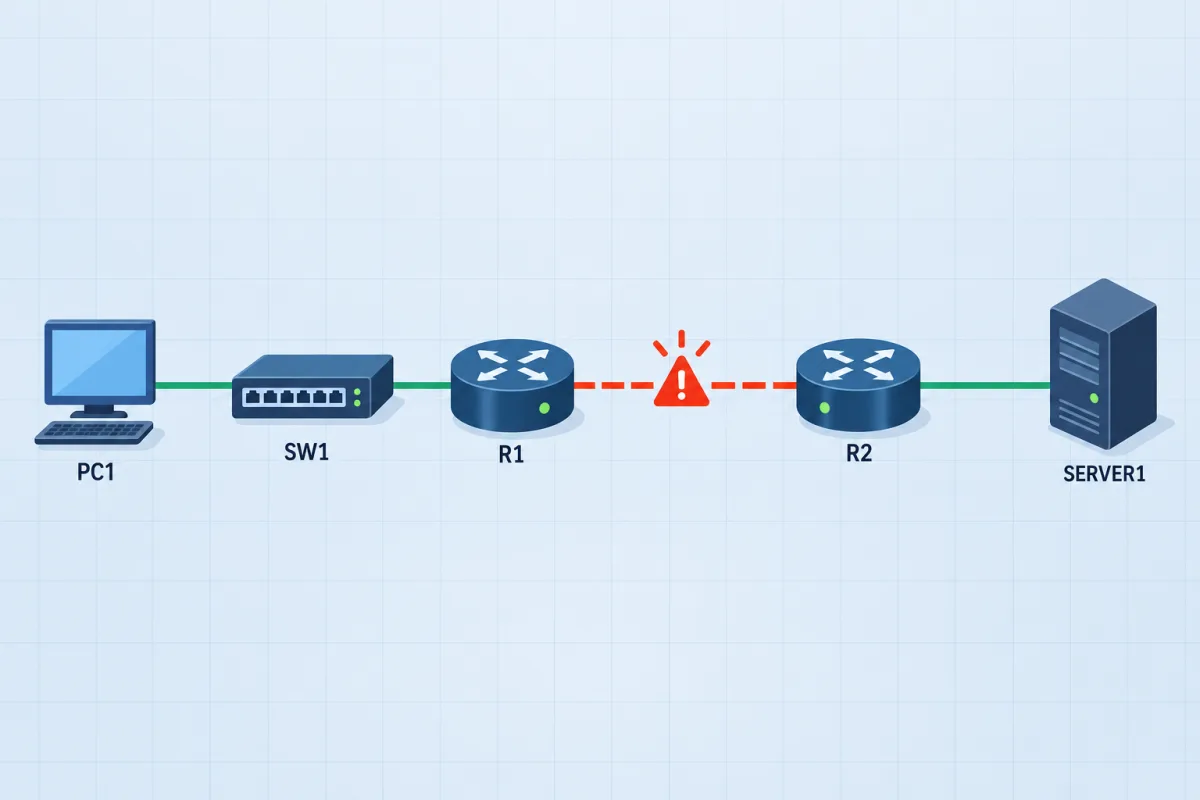
Troubleshooting Practice: 9 scenarios, 28 faults
Nine live networks, each broken on purpose - VLANs, trunks, EtherChannel, STP, static routing, OSPF, NAT, ACLs and DHCP. Find the fault from an IOS command line and the network grades the fix. One scenario is free with the same code.
See the scenarios5 full-length CCNA exams, 510 questions
Every paper is timed to the real CCNA 200-301 format and uses every question type the live exam uses. A complete 103-question paper is free with no credit card.
An Exam Tip on every question
Each item carries a written explanation of why the correct answer is correct and why each distractor fails, plus a separate Exam Tip - the single thing to remember on exam day.
Exam Coach: a concept-level report
Finishing a CCNA 200-301 paper returns a per-concept breakdown across every domain rather than a bare percentage, naming the concepts that cost you marks.
Study Path: revision ranked by what it is worth
Your CCNA 200-301 result is scored against the published blueprint weights and ranked by weighted shortfall - domain weight multiplied by your miss rate. That is why IP Connectivity at 25% of the blueprint outranks a domain you scored worse on but which carries half the weight.
Study cards from your own mistakes
Select any explanation and save it as a study card. Your CCNA deck is built from the questions you actually got wrong, which is the only revision list worth carrying into the final week.
A free CCNA study guide
A full written CCNA 200-301 study guide, readable online with no PDF gate and no email wall, free whether or not you ever buy a pack.
$39 once, lifetime, future versions included
One payment unlocks all 5 CCNA 200-301 exams and all 9 Troubleshooting Practice scenarios for life - about $7.80 per full-length paper. When the blueprint changes, the new versions are included rather than sold as a new edition.
30-day money-back guarantee
Thirty days to ask for the money back, on top of sitting a complete CCNA 200-301 paper free before paying anything.
Figures read from the live CCNA 200-301 question banks on 6 October 2026. Compare against every other CCNA option in the ranked comparison, or start the free 103-question paper with code CCNA-EXAM-FULL.