CCNA 200-301 v2.0 (February 2027): What Changed, and What to Do About It
Cisco is refreshing the CCNA. Version 2.0 becomes available on 3 February 2027, and the last day to sit the current v1.1 exam is 2 February 2027. The exam number does not change - it is still 200-301. Almost everything else about how the blueprint is organised does. Six domains become five, and the single biggest shift is not a topic at all: troubleshooting is back after five years away, and it now runs through roughly a quarter of the exam topics.
Find out where you stand before the blueprint moves
A full-length CCNA 200-301 practice exam, free, with an explanation and an Exam Tip on every item and a personalized Exam Coach at the end. Whichever version you sit, the fundamentals it tests you on carry across. Create an account on the next screen and the code applies itself.
CCNA-EXAM-FULL
Start the free exam
Already have an account? Log in to start · Prefer a 5-question taster first? Try the short version.
In This Guide
The dates that matter
| What | When |
|---|---|
| Last day to sit CCNA 200-301 v1.1 | 2 February 2027 |
| CCNA 200-301 v2.0 becomes available | 3 February 2027 |
| Exam number | Unchanged - still 200-301 |
| Exam length | Unchanged - 120 minutes |
| Certification you earn | Identical. There is no "v1.1 CCNA" on a transcript |
There is no overlap window and no grace period, because there is nothing to overlap: the exam code stays the same, so on 3 February the questions behind 200-301 simply become the v2.0 questions. If you have a v1.1 exam booked for 3 February or later, you will be sitting v2.0.
Six domains become five: the real weights
This is the part most write-ups are still guessing at. The numbers below are read directly from Cisco's published exam topics documents for each version, not inferred.
v1.1 - the current exam
Until 2 February 2027
- 1.0 Network Fundamentals20%
- 2.0 Network Access20%
- 3.0 IP Connectivity25%
- 4.0 IP Services10%
- 5.0 Security Fundamentals15%
- 6.0 Automation and Programmability10%
v2.0 - from 3 February 2027
Five domains, reorganised
- 1.0 Network Infrastructure and Connectivity25%
- 2.0 Switching and Network Access25%
- 3.0 IP Routing20%
- 4.0 Network Services and Security20%
- 5.0 AI, and Network Operations and Management10%
Read across rather than down, because the domains were not renamed one-for-one - they were redrawn. Three consequences are worth acting on:
- Switching gets much heavier. "Network Access" was 20% and shared its space with wireless. In v2.0, Switching and Network Access is 25% and is unambiguously about switch configuration: trunks, EtherChannel, SVIs, edge-port attributes for phones, APs and IoT devices, and Rapid PVST+ with PortFast, root guard, loop guard and BPDU guard. If you have been treating spanning tree as a topic to skim, stop.
- Security stopped being its own domain and got more practical. The 15% "Security Fundamentals" domain is gone as a heading; security now shares domain 4.0 with network services at 20% combined. The content shifted from describing threats and explaining concepts toward configuring things: AAA clients with TACACS+ and RADIUS, IPv4 ACLs, and a full Layer 2 hardening list DHCP snooping · DAI · storm control · RA guard · port security.
- Automation and Programmability no longer exists as a domain. Its 10% did not simply move - most of it was cut, and what survives sits inside the new 10% domain 5.0 alongside AI and network management.
The change nobody is talking about: the verbs
Domain weights get the attention, but the more consequential change in v2.0 is grammatical. Cisco writes each exam topic with a verb, and the verb tells you what you will be asked to do. v1.0 and v1.1 leaned on describe, explain and configure and verify. v2.0 brings back two verbs that had been absent from CCNA for five years:
| Verb | What it asks of you |
|---|---|
| Diagnose | Find the problem. You are given output and have to identify what is wrong. |
| Troubleshoot | Find the problem and fix it. The higher bar of the two. |
| Configure / verify | Build it and prove it works. Still present, still heavily tested. |
| Describe / interpret | The knowledge-recall tier. Present, but a smaller share than before. |
Around a quarter of the v2.0 exam topics carry a troubleshoot or diagnose verb. Look at what specifically got upgraded and the pattern is obvious - it is all the things that break in a real job on a Monday morning:
- 1.1 Diagnose interface and cable issues: collisions, errors, duplex and speed mismatch, distance, signal levels, pin-outs, copper versus fiber.
- 1.3 / 1.4 Troubleshoot IPv4 and IPv6 addressing, assignment and subnetting - not calculate a subnet in the abstract, but find the wrong one in a live config.
- 1.6 Troubleshoot wired and wireless client connectivity on Windows, macOS and Linux.
- 1.7 Troubleshoot DHCPv4 client, server and relay on IOS devices.
- 2.4 Troubleshoot Layer 2 and Layer 3 connectivity using show commands including
show logs, ping, extended ping, traceroute and packet capture output. - 3.2 Troubleshoot IPv4 and IPv6 static routing, including floating statics.
- 4.4 Diagnose DNS record problems - A, AAAA, CNAME, MX, NS and PTR - to explain why a host, web app or mail server is unreachable by name.
show output, where three of the four options are plausible failures, are the closest thing to the new format.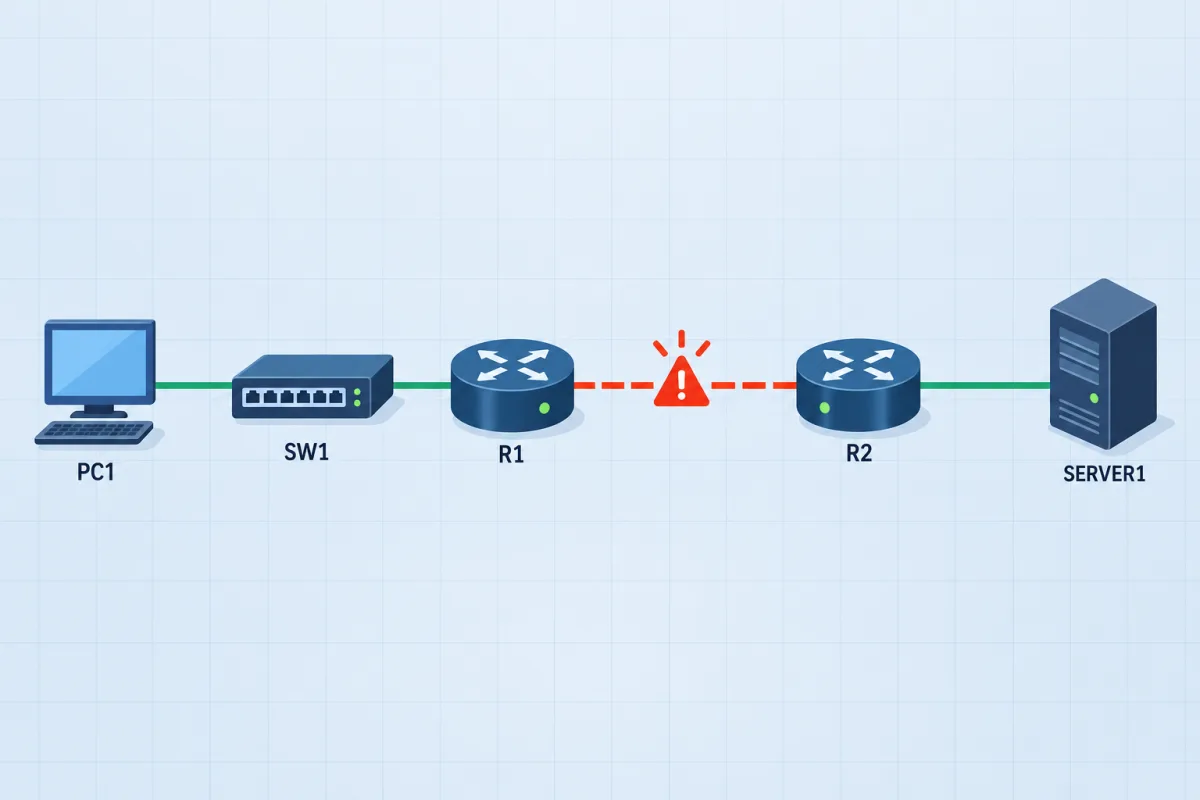
Practise the new verbs on a live network
9 broken networks, each mapped to the v2.0 topic it drills - static routing (3.2), Layer 2 and Layer 3 connectivity (2.4), DHCP (1.7) and more. Find the fault with show commands, ping and traceroute, fix it, and the network grades the repair.
See the scenarios and the topic mapWhat is new in v2.0
AI arrives on the CCNA
Domain 5.0 is named "AI, and Network Operations and Management", and Cisco's own exam description says candidates "may be required to evaluate output and recommendations from agentic AI and digital network assistants to support network operations and troubleshooting activities." Two topics make it concrete:
- 5.1 Describe the role of agentic AI in network operations.
- 5.2 Select a prompt to send to a generative AI system to support network operations, considering prompt components such as data classification, output format, persona and instructions.
Topic 5.2 is unusual and worth reading twice. It is a prompt-writing question on a Cisco exam, and the reference to data classification is the giveaway - the wrong answers will be prompts that paste customer data or device credentials into a public model. Treat it as a judgement item, not a technology item.
Other genuine additions
- Ansible is named explicitly (5.5, "use configuration management mechanisms such as Ansible to execute commands") - the one automation tool that survived the domain being dissolved.
- Hypervisors, virtual machines and containers (1.2) replace the older, vaguer virtualization topic.
- SFTP and SCP (4.2) for managing configuration and software files securely.
- Packet capture output joins ping, traceroute and show commands as a troubleshooting input (2.4).
- RA guard and storm control join DHCP snooping, dynamic ARP inspection and port security in the Layer 2 hardening list (4.7).
- Syslog severity levels and facilities (5.6) and SNMP (5.4) are called out individually.
- Infrastructure as code appears as a named network management approach alongside device-based, cloud-based, controller-based and automation-based (5.3).
What is gone
If you are mid-study on v1.1 material and your exam will land after 2 February, this is the list to stop spending time on:
- The automation stack. REST APIs, JSON data encoding, and the Puppet/Chef/Ansible comparison are no longer a domain of their own. Ansible survives as a single command-execution topic; the rest went with the domain.
- Wireless configuration depth. v2.0 keeps "describe wireless principles" - band and channel selection, RF characteristics, security protocols, sources of interference - and it keeps troubleshooting a wireless client. What it drops is configuring WLANs on a controller through a GUI.
- Explaining security in the abstract. Threat and vulnerability definitions, the elements of a security program, and the physical-access discussion give way to configuring the controls themselves.
- Some standalone service topics. Domain 4.0 is tighter than the old IP Services domain: NAT/PAT, DNS diagnosis, ACLs, AAA, secure file transfer and IPsec VPN description. FHRPs survive but only at the interpret the operational status tier for HSRP and VRRP, not full configuration.
Sit v1.1 or wait for v2.0?
The certification is identical either way, so this is purely a question of which exam you are better prepared for on the day. Find yourself below.
| Where you are | What to do |
|---|---|
| Studying now, can be ready by January | Sit v1.1. Every course, lab and question bank you own is aligned to it, and you avoid being an early candidate on a blueprint whose material has not caught up yet. |
| Starting from zero today | Aim at v2.0. You would be racing a deadline to learn a version that expires, and roughly a fifth of what you learned would be reorganised under you. Use v1.1 material for the fundamentals - they do not change - and add troubleshooting practice. |
| Already failed once and resitting | Resit v1.1 if you can do it before 2 February. You already know the format, and your score report points at gaps in a blueprint that still exists. |
| Timeline is genuinely uncertain | Study the overlap first, which is most of it: subnetting, switching, OSPF, static routing, ACLs, NAT, DHCP, DNS. Those appear in both versions. Decide in December when you can see your own progress. |
| Already CCNA certified | Nothing to do. Your certification is valid for three years from the day you earned it, whatever version you sat. |
One practical note for the "ready by January" group: do not leave the booking until the last week. Test-centre slots ahead of a version change fill up, and if you get pushed to 3 February you sit v2.0 with v1.1 preparation.
Why the dumps sold online go worthless on 3 February
There is a seasonal pattern around every blueprint change, and it is starting now: sites that sell "latest 2026 CCNA questions" push hardest in the months before a version flips, because that is when their stock is closest to still being current. What they are selling is a fixed set of remembered items harvested from the v1.1 pool. Nobody rewrites it against a new blueprint - the business model does not include authors.
So a bundle bought in November 2026 has a hard expiry of 2 February 2027, and it is worse than that in practice:
- The reorganisation invalidates more than it looks like. A v1.1 item testing "explain the role of REST APIs" is not merely re-weighted in v2.0, it has no domain to live in.
- Dumps cannot follow a verb change. Their entire format is recall of a question and its remembered answer letter. That is structurally incapable of preparing you for "here is a
showoutput, what is broken and what fixes it", which is where a quarter of v2.0 now lives. - The remembered answers were never reliable. Items are transcribed from memory by people who, by definition, were unsure enough to be looking at a dump. Wrong answer keys propagate through these sets for years.
- Using them breaks the agreement you sign at the test centre. Cisco's exam policies treat this as misconduct, and the sanction is your certifications, not a refund.
The honest alternative is not "study harder", it is to practise on questions that are written against the current blueprint and maintained when it moves - so a version change means your material gets updated rather than becoming landfill. We wrote up the full argument, including how to spot a repackaged dump, on CCNA exam dumps: what to use instead.
Practise the part v2.0 leans on hardest
Our CCNA questions are built around output and configs, with an explanation on every item that walks through why the other three options fail - the reading-and-diagnosing habit v2.0 rewards. The first full-length exam is free, and the pack is a one-time purchase with lifetime access, so a blueprint update means updated questions, not a re-purchase.
CCNA-EXAM-FULL
Redeem the code
Already have an account? Log in to redeem
Quick-check questions on the v2.0 change
Five questions to confirm you have the 2027 change straight, each with a full explanation.
Where to go next
You know what is changing. Now find out where you actually stand:
Frequently asked questions
When exactly does the CCNA change in 2027?
CCNA 200-301 v2.0 becomes available on 3 February 2027, and 2 February 2027 is the last day to sit v1.1. The exam number does not change - it stays 200-301, with the version moving from v1.1 to v2.0. Because the number is the same, there is no overlap window: an exam sat on 3 February is a v2.0 exam.
Should I take the CCNA before February 2027 or wait for v2.0?
If you can realistically be ready before 2 February 2027, sit v1.1 - your material is aligned to it today and the certification you earn is identical. If you are starting from scratch now, or your timeline is likely to slip, study for v2.0 directly rather than learning a structure that is about to be redrawn. The fundamentals overlap almost entirely; it is the emphasis and the question style that move.
Is CCNA v2.0 harder than v1.1?
Different, and more demanding in one specific way. Around a quarter of the exam topics now use troubleshoot or diagnose verbs instead of describe or explain, which means finding and fixing a fault rather than reciting a definition. Pure memorisation carries you less far. On the other hand, the automation domain that many candidates found alien has largely gone, so the exam is more concentrated on core networking.
Does my existing CCNA expire or change when v2.0 launches?
No. If you are already certified, the launch does not affect your credential. Cisco certifications run three years from the date you earned them regardless of blueprint version, and updates apply only to future test takers. There is no "v1.1 CCNA" versus "v2.0 CCNA" distinction anywhere on a transcript or a CV.
Do I still need to learn Python and REST APIs for v2.0?
Not for the exam. The Automation and Programmability domain was dissolved and most of its content went with it, including REST APIs, JSON encoding and the Puppet/Chef comparison. Ansible survives as one topic about executing commands, and infrastructure as code appears as a named management approach. For your career, automation skills remain valuable - this is a statement about the blueprint, not about the industry.
Are CCNA dumps and question banks still valid for v2.0?
Anything built for v1.1 and not rewritten goes stale on 3 February 2027. That hits paid dump listings hardest, because they are copies of remembered items with nobody maintaining them against a new blueprint - a bundle bought in late 2026 is worth nothing weeks later. They were also unreliable before the change, since the answer keys come from candidates recalling questions they were not sure about, and using them violates the agreement you accept at the test centre.
What is the AI content on CCNA v2.0, really?
Two topics in the 10% domain 5.0. One asks you to describe the role of agentic AI in network operations. The other asks you to select an appropriate prompt for a generative AI system, judged on components like data classification, output format, persona and instructions. Cisco's exam description also warns you may have to evaluate output and recommendations from AI assistants. Read it as judgement about using these tools safely at work, not as a machine-learning topic.